
Farrow & Ball French Gray in a Low-Light Bedroom: The Dove
How Farrow & Ball French Gray looks in The Dove, a bedroom with almost no direct sun: why I chose it, what it sits with, and every paint, fabric and source in the room.
Farrow & Ball French Gray is a soft green-grey, and in my experience it is much more green than its name suggests. I used it on the walls of The Dove, the primary bedroom in our 1875 villa in Switzerland, which gets almost no direct sunlight. Below is how it behaves in a room like that, why I chose it, what it sits with, and the full paint and fabric schedule for the room.
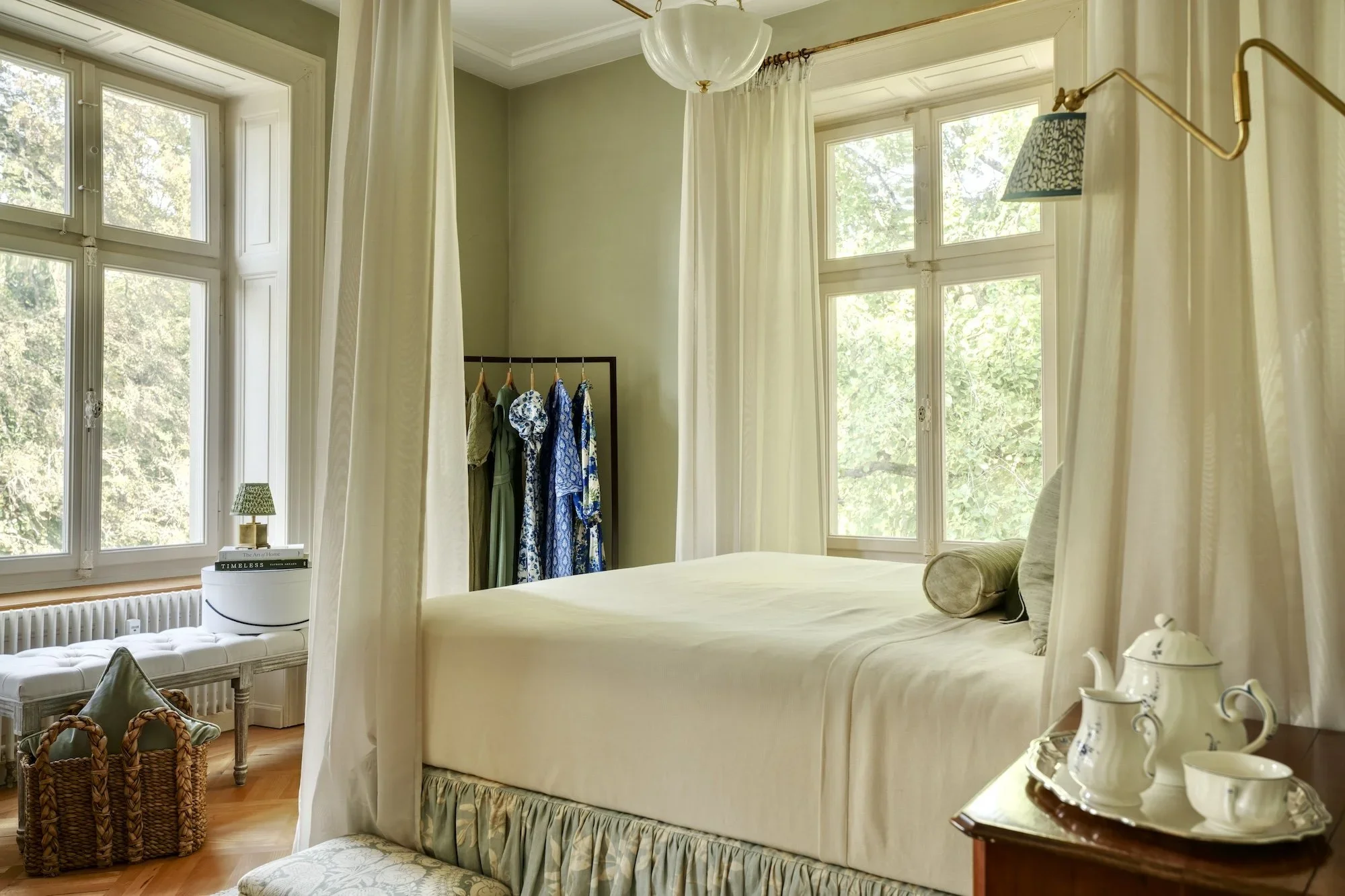
You can see the finished room in the portfolio, and the whole makeover on YouTube.
Is French Gray grey or green?
Mostly green. Farrow & Ball describe it as “much more green than grey”, and say it moves between the two depending on the light and the time of day. They take its inspiration from nineteenth-century French decoration and wallpapers, which is where the name comes from rather than from the colour itself.
As I said in the makeover videos, even though it says gray in the name, it is actually a green.
How it looks in a room with little direct sun
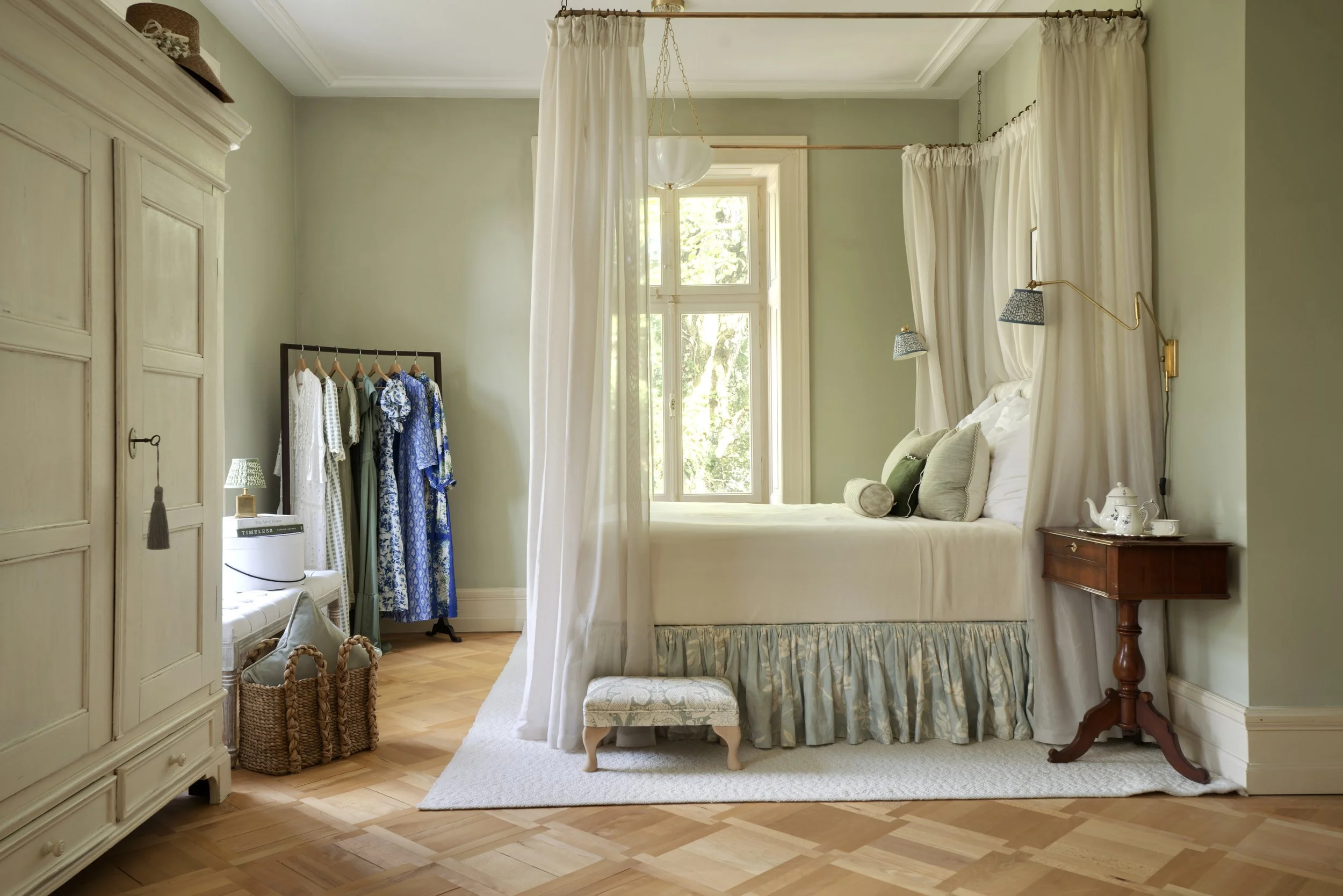
The Dove gets almost no direct sunlight. Its windows are on two walls that meet at a corner. One window catches a little light first thing in the morning, and the two on the other wall catch the sun only as it sets. For most of the day, the room is lit by soft, indirect light.
In a room like this, a colour’s undertone tends to matter more, because there is little direct sun to warm it. If your room is similar, it is worth putting large sample cards on two or three walls and looking at them at the times you actually use the room. For a bedroom, that is usually early morning and the evening, under lamplight.
Why I chose French Gray
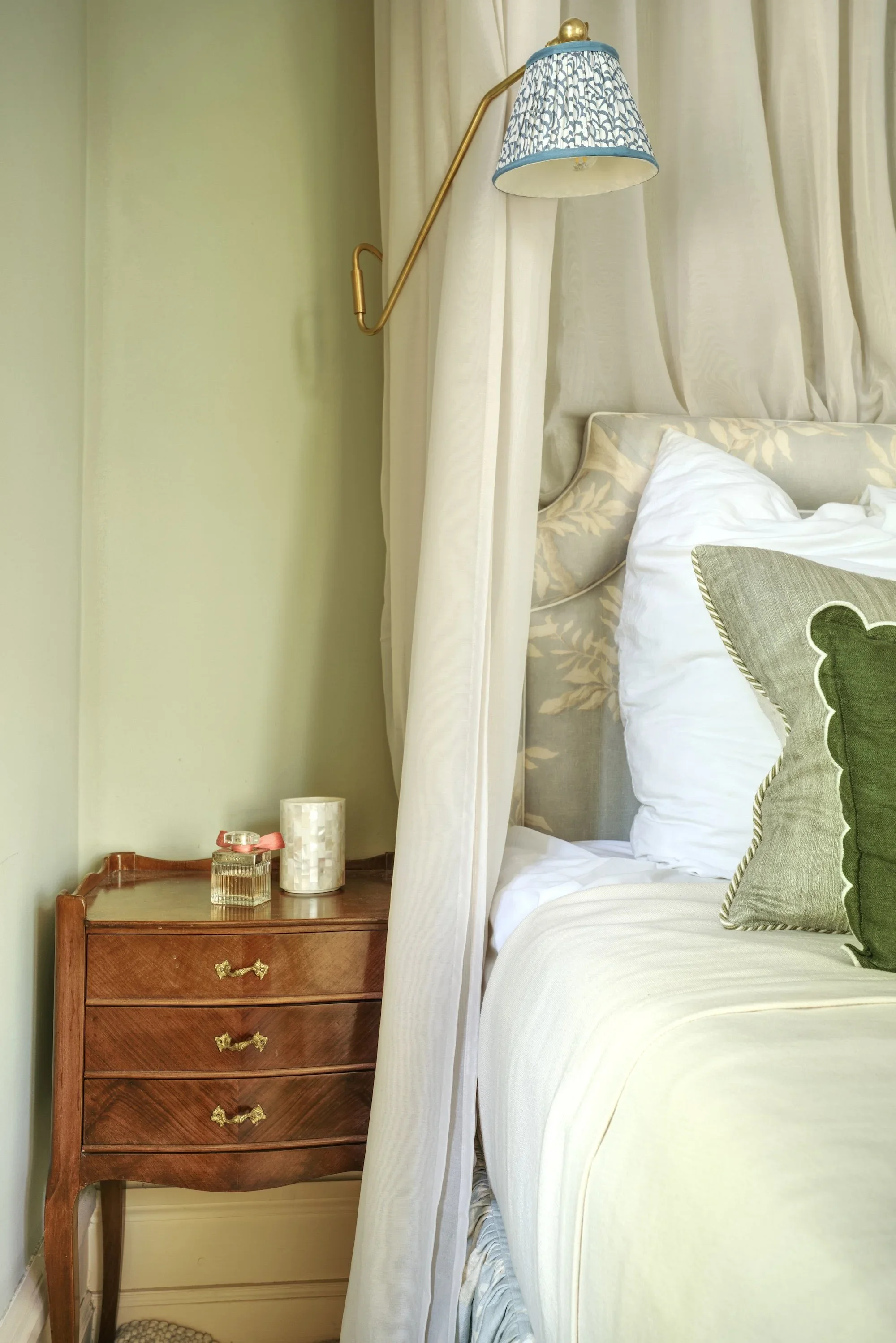
I almost never start a room with the wall colour. The Dove started with the headboard fabric, Doves by Lewis & Wood in Summer Blue. Paint can be mixed in almost any shade, while fabrics and antiques are much harder to find in exactly the colour you want, so I choose those first and match the paint to them.
The headboard is the most visually dominant piece in the room, and I wanted the walls, the other dominant element, to be a different colour from it. I didn’t want a room that was all blue. French Gray sits beside the blues in Doves on the colour wheel, which makes an analogous palette: calm and cohesive, which is what I wanted for a bedroom.
I had a few much darker colours on my list and considered something bolder, but decided they weren’t right for a room I wanted to feel tranquil. I put the paint cards up on the wall and was leaning towards French Gray, and my husband, who has a very good eye for paint, confirmed it.
The one warmer note is raspberry, used in small amounts: the plates on the wall and a few smaller pieces. It is an accent rather than a third main colour.
What to pair with French Gray
Farrow & Ball recommend Slipper Satin as the white to use alongside French Gray, and also suggest Lime White, Off-White and Mouse’s Back as companions.
In The Dove, French Gray sits with:
soft blue: Doves in Summer Blue on the headboard and bed skirt
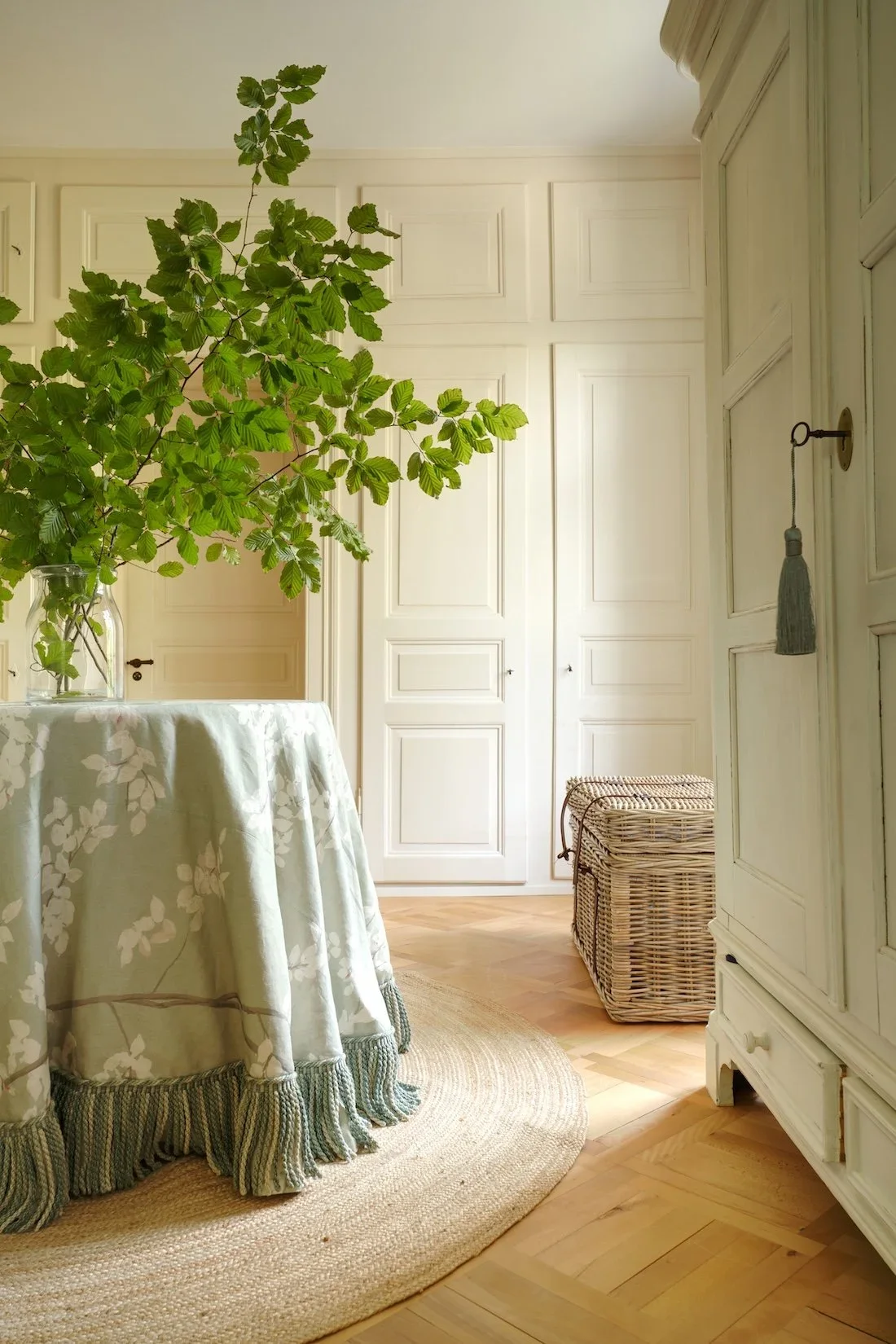
a deeper jade: Beech on the tablecloth
a darker green: the Colefax & Fowler bullion fringe
raspberry, in small amounts
antique brass and dark wood, from the canopy rods and the antique furniture
With a pale wall colour, one or two darker pieces stop the room from feeling too light and airy. In The Dove, that is the throw, which has a larger-scale pattern and darker tones than anything else in the room.
Paint and fabric schedule
Walls: French Gray No. 18, Farrow & Ball
Headboard and bed skirt: Doves in Summer Blue, Lewis & Wood
Tablecloth: Beech in Jade, Lewis & Wood
Trim: Arlington Bullion Fringe in Green, Colefax & Fowler
Bed canopy: voile, on ceiling-mounted rods by Gotain
The fabrics
Doves covers the headboard and the bed skirt, where it is seen most. It was the first design Flora Roberts painted for Lewis & Wood. Beech, a sapling design by the decorative artist Alexander Hamilton, is used in Jade for the tablecloth.
The green Arlington bullion fringe from Colefax & Fowler finishes the edges. Trims are a small cost for how much they add to a room like this.
The bed canopy and plate wall
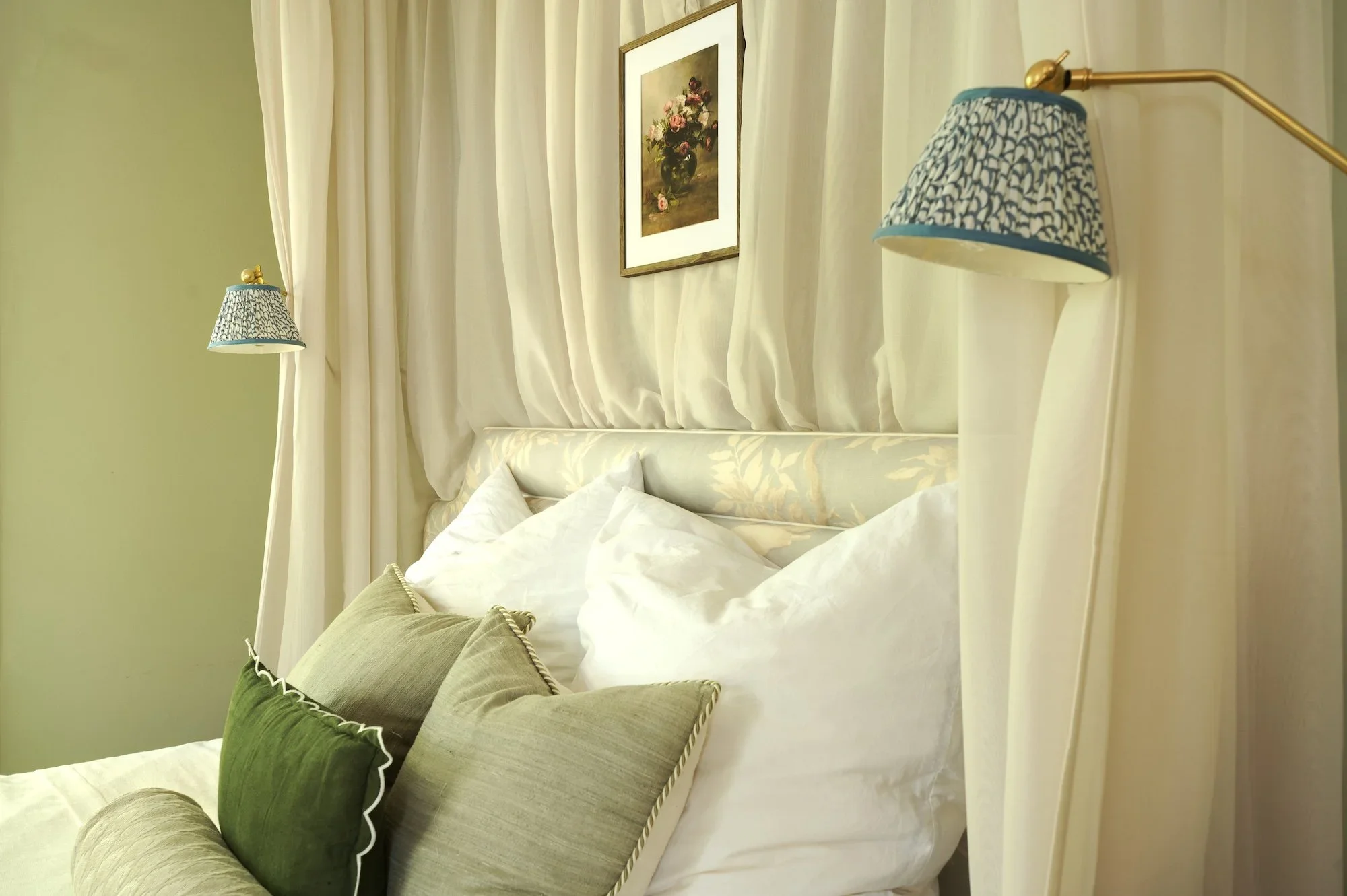
The high ceilings called for something to bring the scale down over the bed. A simple canopy in soft voile, hung from rods fixed to the ceiling, does that without closing the bed in. The raspberry plates are a traditional English design, hung as a group, which gives the room a warm focal point.
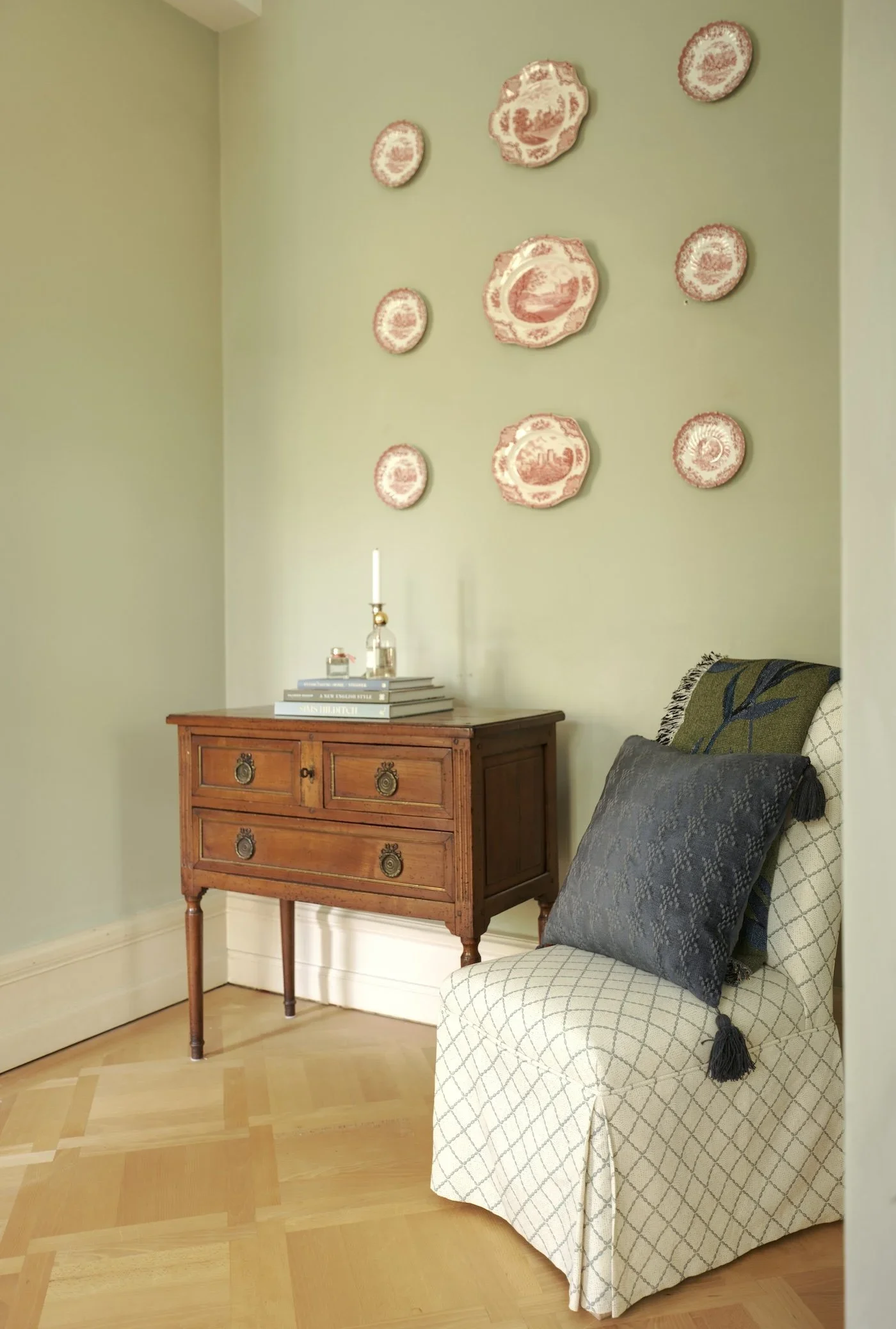
Watch both being installed in Villa Bedroom Makeover Ep 3.
A few things I learned along the way
Check metallic finishes in daylight. I first spray-painted the black canopy rods gold. It looked fine in the evening, but far too bright in daylight, so I redid them with a gilding wax for an antique brass finish.
Hem curtains before you rely on them. I stepped on the unhemmed canopy curtains and pulled the canopy down within a week. They are now shortened to just kiss the floor.
Plan a plate wall on paper first. I cut paper templates of each plate, tried several layouts, slept on it and looked again in the morning light. I settled on a grid and took a few plates away so the wall wasn’t overfilled.
Be willing to take something down. I hung curtains at the window too, but they weren’t adding anything to the room, so they came down again.
Frequently asked questions
Is Farrow & Ball French Gray grey or green?
Mostly green. Farrow & Ball describe it as much more green than grey, and it can look greener or greyer depending on the light.
What white goes with French Gray?
Farrow & Ball recommend Slipper Satin.
Does French Gray work in a room with little sun?
I chose it for The Dove, which gets almost no direct sunlight, because I wanted the room to feel tranquil. Sample it on the walls at the times of day you use the room before you commit.
What fabrics go with French Gray?
In The Dove, soft blues, jade and deeper greens sit well with it, with a small amount of raspberry for warmth.
Shop the room
Some of these are affiliate links, which means I may earn a small commission at no extra cost to you.
Paint: the wall colour
Fabric and trim: the headboard and bed skirt fabric; the tablecloth is Beech by Lewis & Wood; the trim is from Colefax & Fowler
Bed canopy: the canopy curtain rods and four-prong curtain hooks
Walls: prints one, two and three, the frames, the mats and the plate hangers
Cushions and throw: the light green cushions, the dark green scalloped cushion and the throw; the round bolster is from Maison Flaneur
Lighting: the chandelier, the bedside lamps, their shades, and the rechargeable lamp with its shade
Furniture: a similar slipper chair; the mirror is an antique from Village des Antiquaires in France
Designing a room like this
If you would like a room designed in this style, Online Design is available wherever you live, with a paint and fabric schedule and shopping list like the one above. For homes in Switzerland, Full Service Design takes a project from first meeting to installation. Please do enquire.
What To Expect To Invest: An Insider’s Guide to Interior Design in Switzerland
Transforming your home into a space that is inimitable, deeply personal, and yet striking enough it could rival the pages of Architectural Digest or House & Garden requires one essential element: An exceptionally talented interior designer.
Of course, the services of an interior designer are a luxury afforded only to a select lucky few, but no matter how grand a home, we’re all working to an interiors budget of some sort. Whether that be 40,000 CHF or 400,000 CHF, it’s important to go into a project with clear eyes about what kind of investment we’re looking to make.
So here is your definitive insider's guide to the finer details on the financial side of high end interior design services in Switzerland.
How much does an interior designer cost in Switzerland?
There are multiple elements to how interior designers price services, often with each different phase of an interior design project having its own billing method, so let’s start with the fundamentals of the interior design process and how each element is priced.
Phase 1: Interior Design
This first phase of a project is what you expect when you think of what an interior designer actually does. A designer reviews your space (or the project plans if the home is a new build), you align on mood boards, design styles, and the designer produces floorplans, elevations, digital models of the room, and finally FF&E schedules. (That is insider speak for “shopping lists.”)
This phase of a project is most often charged hourly or sometimes as a flat fee. Hourly rates for interior designers in Switzerland range from 130 CHF to 300 CHF per hour.
You will find, as in every industry, lower rates with solo operators and lesser-experienced designers, and higher rates with larger established firms and highly experienced professionals.
Additionally, there is also of course the “Zurich & Geneva premium” in Switzerland. Interior designers in Switzerland’s two most populous cities of Zurich & Geneva tend to fall on the higher side of the hourly rate scale.
Of course, the next immediate question arises: how many hours will my project take? Do contact us for a personalised assessment for your specific project, or alternatively, we have put together a sample Swiss interior design project budget below.
Phase 2: Interior Design Procurement
Procurement is the process of actually acquiring the hundreds or potentially thousands of items needed to bring the design plans to life from trusted sources.
Designers most often work with trade-only vendors whose quality and terms can be trusted. This means clients who choose to work with interior designers unlock access to exclusive global houses, bespoke ateliers, and custom one-off pieces that are not available for purchase on the open market. Access to these vendors is something only a small fraction of the world’s population ever gets a chance to have, and many discerning clients find the access to incredibly unique artisans to be an invaluable perk.
Procurement itself is no small undertaking, with larger projects sometimes taking months of human time to specify, order, manage, and coordinate. But procurement doesn’t simply stop at placing an order. An interior designer's real task is to make a client's interior dreams come to life with as minimal hassle as possible. Procurement extends to reviewing and handling damaged or faulty items (of which there are unfortunately many in every single project) and coordinating deliveries to the site exactly when they’re needed.
To give you a realistic sense of scale, industry-standard procurement markups for high-end residential projects in Switzerland typically range from 20% to 35% of the retail cost of the goods. For a multi-million-franc estate overhaul, this percentage covers the exhaustive administrative load: managing international wire transfers, navigating Swiss customs import duties and 8.1% VAT, coordinating secure climate-controlled warehousing while construction finishes, and vetting every single piece upon arrival.
Procurement is billed in mainly two methods:
Percentage markup
Percentage markup + hourly rate (130 CHF - 300 CHF/hour)
Phase 3: Interior Design Project Management
How intensive the project management phase is depends highly on the type of project completed. Here at Deirdre von Gruben, we categorise our projects into three distinct levels:
“Paint, Paper & Furnish”: A full concept design implemented via painting, wallpapering, furnishings, window treatments, and decor.
“Full Redesign”: Everything in Paint, Paper & Furnish plus flooring replacement, millwork, and cabinetry. Involves specialised tradespeople.
“Construction & Full Gut”: Everything previously listed plus layout changes, moving walls, or a full "to-the-studs" renovation / new build. Involves an architect and building team.
Project management is almost universally charged hourly, ranging between 130 CHF and 300 CHF per hour in Switzerland. Unlike the design phase where a flat fee can often be quoted, a designer's project management time is driven largely by factors outside their control (such as the pacing of external tradespeople), making hourly billing the industry standard.
Phase 4: Interiors Installation
The beauty of working with an interior designer is the cinematic moment we’ve all seen on design shows: walking into your perfectly completed home. This is made possible by the installation phase, where a designer oversees the final placement of goods and perfects every detail.
Installation may take a day for a smaller project or multiple weeks for a larger estate, and is typically charged hourly or as a flat per diem ranging between 600 CHF and 1,500 CHF per person, per day. For high-net-worth and international clientele, this includes private collection sourcing, custom lighting engineering for fine art, and meticulous "styling days" with professional decorators.
Other Key Line Items in Swiss Interior Projects: Travel and Denkmalschutz Coordination
Travel: Interior designers frequently undertake sourcing trips to antique markets in Paris, the Chelsea Design Centre in London, or showrooms in Milan. Most designers charge for travel time hourly alongside at-cost travel expenses (typically 200 CHF to 700 CHF per trip for a short-haul flight and stay in London or Paris). At Deirdre von Gruben, almost every project involves at least one sourcing day at one of the design districts in Europe. For a taste of what one of these trips looks like, do join us for a trip to the Paris Design District below.
Furthermore, designers bill for travel to and from client projects. Consequently, how far your property is from the designer’s office base becomes a critical factor—especially for projects requiring heavy construction or frequent trades oversight. While some international clients initially consider hiring a London- or New York-based designer to manage a chalet in Verbier or a villa in Zurich, the compounding travel fees and flight hours quickly add up.
Choosing a local, internationally experienced studio rooted in Switzerland bypasses these travel costs entirely while keeping your project supervised on the ground.
Denkmalschutz (Historic Preservation Office) Coordination: Projects in historic Swiss homes often require planning permissions from heritage preservation boards (Denkmalpflege). Because navigating these boards requires delicate diplomatic negotiation and precise documentation, specialised coordination is billed at standard hourly rates (130 CHF to 300 CHF/hour).
Project Minimums and Retainers: The Reality of Prestigious Design Studios

When you are engaging an elite interior design studio or a celebrated "tastemaker" designer whose work routinely graces international design publications, you are purchasing more than just billable hours—you are securing dedicated, high-touch manpower and exclusive creative bandwidth.
Because executing a holistic estate transformation requires an exhaustive level of project management and white-glove coordination, top-tier studios almost universally operate on project minimums or retainer structures.
It is standard practice for high-end Swiss studios to decline commissions where the design fee falls below a certain threshold (often starting around 30,000 CHF to 70,000 CHF for single-room projects, and significantly higher for full-home overhauls). Furthermore, these studios require an upfront design retainer or monthly management fee to secure their schedule—acting as the ultimate quality assurance guarantee for the client.
At the end of the day, when you are investing in a top-tier interior designer, you aren't simply paying for floor plans, mood boards, or fabric samples. You are buying ease.
You are paying for a completely ready-to-live-in home with none of the endless administrative friction or logistical problems landing on your plate. This is especially vital for international buyers—whether you’ve acquired a historic villa in Canton Zurich or an alpine chalet in Verbier while living abroad.
An elite interior designer acts as your trusted local proxy in Switzerland, shielding you entirely from operational chaos: managing Swiss contractors who speak local dialects, handling time-zone-friendly reporting, and supervising every minute detail. Instead of fielding frantic calls about delayed shipments, your only job is to step into a fully finished, exquisitely styled home without ever lifting a finger.
Here at Deirdre von Gruben, creating exceptional spaces—from historic Swiss villas to luxury alpine ski chalets for international clients—is our speciality. Because our principal designer, Deirdre von Gruben, is an international living and working in Switzerland, we uniquely understand the perspective of clients navigating the Swiss design landscape from afar, serving as your trusted local partner every step of the way.
Non-Designer Costs: The Execution Budget
Furnishings, Fixtures, & Decor (FF&E): The physical investment in bespoke upholstery, lighting, custom rugs, antiques, and hardware. For a single statement room, furniture investments range from 35,000 CHF to 70,000 CHF+.
Import Fees, Shipping, & Secure Warehousing: The vast majority of high-end furnishings come from abroad (the UK, France, and Italy). While retail brands often exclude Switzerland all together making purchasing from retail vendors nearly impossible, trade vendors used by designers almost always do universally ship to Switzerland. You must account for Swiss customs clearance and the 8.1% Swiss VAT on every purchase. However, beware of the parcel carrier trap: major couriers such as DPD and DHL charge a baseline clearance fee per box of 25 CHF, so a professional procurement team consolidates orders into strategic shipments rather than shipping dozens of small boxes individually. Finally, secure climate-controlled Swiss warehousing ranges from 300 CHF to 1,000+ CHF per month.
Specialised Tradespeople & Artisans: Independent tradespeople (electricians, master painters, wallpaper hangers, fine cabinet makers / Schreiner, and stone masons) bill directly for their time, typically commanding 110 CHF to 180 CHF per hour.
Sample Budget: Living Room "Paint, Paper & Furnish" Project
To make these figures tangible, let’s examine a classic, highly requested scope: a comprehensive "Paint, Paper & Furnish" transformation for a grand living room in a Swiss home.
The Design Phase & Sourcing Travel: Spatial floor plans, elevations, lighting plans, FF&E schedules, plus one international sourcing day in London or Paris (CHF 7,700 – CHF 14,500).
Furnishings, Decor, & Procurement (FF&E): Bespoke upholstery, custom club chairs, antique accent tables, hand-knotted rugs, and architectural lighting purchased at standard retail pricing (CHF 35,000 – CHF 70,000).
Project Management & Specialised Coordination: Oversight of artisans and international shipments (approx. 12 hours @ 190 CHF/hr) (CHF 2,280).
Warehousing (4 Months): Climate-controlled storage for consolidated inventory prior to installation (CHF 1,600).
Specialised Trades, Installation & Movers: Master painters, wallpaper hanging, custom drapery installation, and professional white-glove moving services (CHF 3,500 – CHF 7,000).
Final Styling & On-Site Installation Per Diem: Dedicated 1-to-2 day white-glove placement and magazine-ready styling (CHF 1,200 – CHF 2,500).
Total Estimated Investment Summary: Living Room Project
Professional Design, Travel, Management & Installation Services: ~CHF 12,480 – CHF 20,780
Physical FF&E (Furniture, Lighting, Decor & Antiques): ~CHF 35,000 – CHF 70,000
Warehousing, Specialised Trades (Wallpaper/Drapery), Movers & White-Glove Execution: ~CHF 6,300 – CHF 13,100
Estimated Total Project Investment: ~CHF 53,780 to CHF 103,880+
(Note: Excludes cross-border import VAT and parcel clearance fees, which scale relative to specific international shipments.)
What the Design Process Looks and Feels Like: The Grand Reveal
Beyond the spreadsheets, hourly breakdowns, and logistics, what is it actually like to partner with a high-end interior design studio?
When you entrust your property to a top-tier team, the chaotic reality of a multi-month renovation or cross-border furnishing project melts away behind the scenes. While custom cabinetry is being engineered, antiques are being hand-sourced from hidden ateliers in Paris or London, and delicate shipments are quietly arriving, your life remains entirely uninterrupted.
On installation day, your designer and their white-glove team take over. Furniture is placed down to the millimeter, fine art is precisely hung and lit, books are arranged, and fresh styling elements are layered into place. When you finally return, turn the key, and walk through your front door, you aren't walking into a construction zone or a house full of boxes. You are walking straight into a master-planned, deeply personal masterpiece that looks like it has been lived in and loved for generations—ready for you to pour a glass of wine and host your first dinner party that very evening.
As you can see, answering “How much does an interior designer cost in Switzerland?” is rarely a matter of a single, straightforward figure. With multiple phases of service, varying scopes of work, and distinct pricing structures—from design retainers and hourly rates to specialised international procurement—every project is uniquely tailored to its home and owner.
While sample budgets provide a valuable baseline, the most straightforward way to understand what your specific vision will require is a direct conversation.
Whether you are looking to revitalise a historic estate in Canton Zurich or curate a classic alpine ski chalet from abroad, we would love to help you bring it to life.
Get in Touch with Deirdre von Gruben: Let’s talk about your property, your vision, and how we can make the entire process effortless for you.