
You have found the villa: ceilings well over three metres, the original oak parquet, a tiled stove in the corner of the salon. Then come the questions no estate agent answers. Which of these features can you change? Will the heritage office let you move the kitchen? And in a country of sleek contemporary showrooms, where do you find a traditional kitchen, or a properly made bed canopy?
We design English country house interiors for period homes in Switzerland, and we live in an 1875 villa ourselves, so these are questions we first had to answer for the house we live in. Here is what we have learned.
This guide contains some affiliate links: if you buy through them, we may earn a commission at no extra cost to you.
Which original features should you keep?
Our starting point is simple: if you would choose it again today, keep it.
Parquet. We almost always keep the original floors. A worn oak parquet can be sanded and refinished, and nothing new has quite the same depth. The exception is a floor laid in a very intricate pattern with several contrasting wood tones. If it is not a floor you would put in today, it is worth considering a replacement, subject to the heritage office (see below).
Joinery, door handles and window fittings. Panelling, cabinetry, door surrounds and antique handles are usually of a classic, timeless design, and they are what make the rooms feel genuinely old. Keep them, repair them, and design around them. The espagnolettes on the windows of the villa we live in are one of our favourite details.
View this post on Instagram
Espagnolettes on the tall windows of a Paris apartment by Abkasha: one handle turns the rod that locks each window top and bottom.
Windows. Original windows are rarely as efficient as modern ones, but they are often exactly what the Denkmalpflege asks you to keep. Sometimes a feature stays because it must, not because it was chosen. The good news is that a well-made pair of interlined curtains does a great deal for warmth and comfort.
Tiled stoves. This is a personal decision. Some families love the history of a Kachelofen; others find that a large stove fills a wall they would rather use. If the stove does not suit how you want to live in the room, removing it is a reasonable conversation to have, though in a listed house it will be a conversation with the heritage office as well.
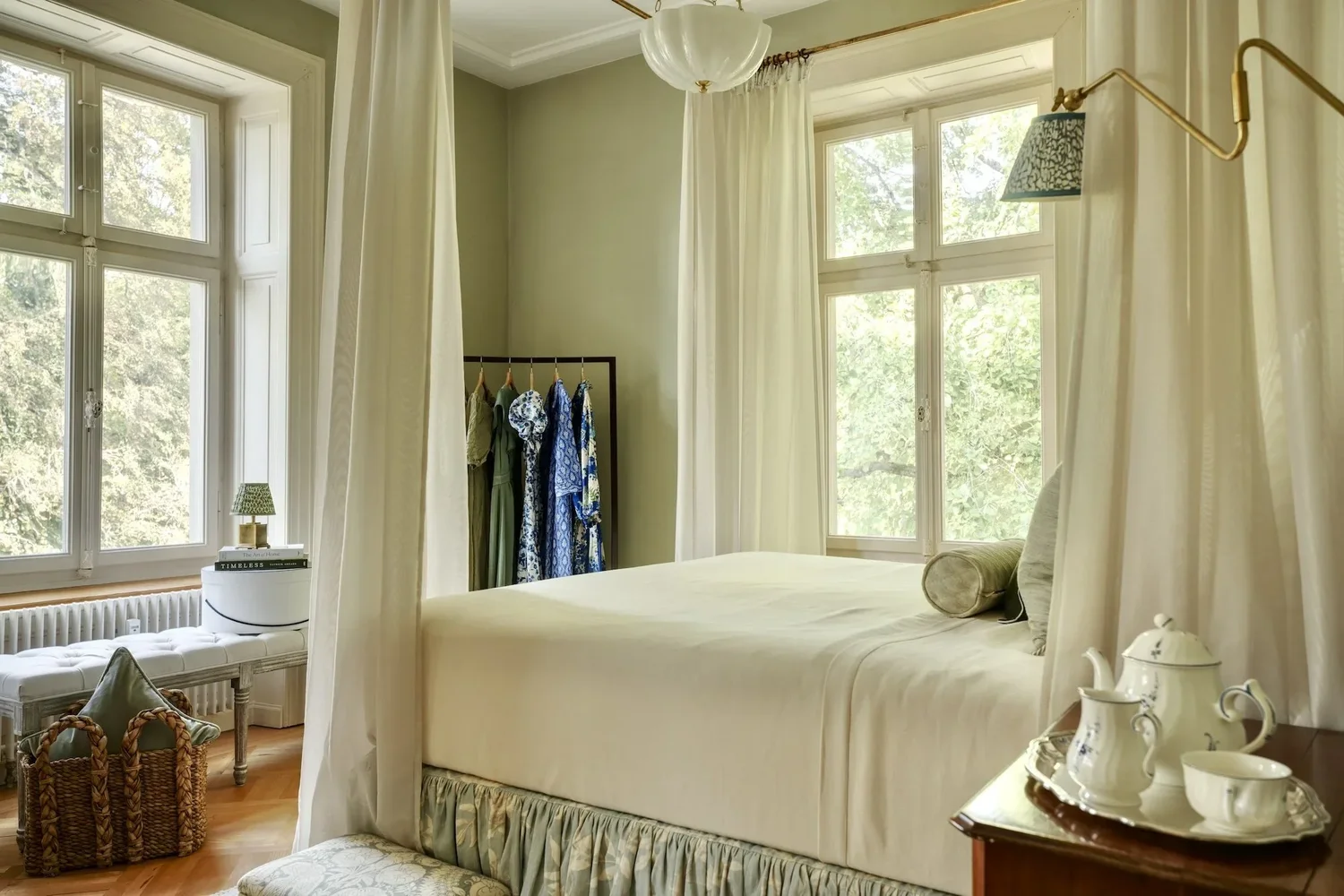
Talk to the Denkmalpflege before you buy
If there is one piece of advice we would give a family looking at a period villa, it is this: speak to the cantonal heritage office before you sign.
Many historic villas are listed in a cantonal or municipal heritage inventory. In Canton Zurich, being in the inventory records a presumption of protection, and building applications for these houses are passed to the cantonal Denkmalpflege for review. You can check whether a property is listed on the canton's online map (maps.zh.ch), and the Denkmalpflege can tell you who your contact is for that area. Other cantons have their own heritage offices and inventories.
Why it matters before the purchase:
Protection is decided house by house. It may cover only the facade, or particular interior features such as an unusual parquet, stucco, a historic tiled stove or an original wallpaper. Knowing which before you buy tells you what you can realistically change.
Windows. A common sticking point. Original timber windows are usually expected to stay, or to be replaced like for like.
Moving the kitchen or bathrooms. A 1980s kitchen is not what the heritage office protects, but moving it can mean running new pipes through original floors and walls. If you plan to move rooms around, ask first.
Wallpaper. In the villa we live in, painting needed no permission, but the wallpaper we chose for the nursery did.
Heritage offices often offer free advice consultations, and they are worth using: an early conversation saves paying for plans that will not be approved.
Canton Zurich has also proposed changes to its planning law that would make some alterations to listed buildings easier, for example for energy improvements. At the time of writing these are still before the cantonal parliament, so check the current rules for your property.
How to rethink the rooms for modern family life
Bathrooms. A villa built in the 1870s would rarely have had a dedicated bathroom. Dedicated bathrooms only began to appear in well-off households in the late 19th century, becoming common around 1900, which is why so many period houses have bathrooms squeezed into odd corners and former cupboards. One of the best changes you can make is to give a whole room to a generous bathroom, often combined with a dressing room.
Kitchens. The original kitchen was usually in the basement or at the back of the house, but most villas were modernised long ago. The more useful question is whether the kitchen a previous owner placed in, say, the 1980s is still in the right room for how your family lives.
Opening up walls. The rooms in these houses are generous, so there is rarely a need to knock rooms together. We are also seeing a move away from open-plan living, and the closed rooms of a villa, connected by an enfilade (doors aligned so you can see from one room through the next), suit that well. We keep the original layout wherever we can and change the use of rooms rather than their walls.
View this post on Instagram
A bath, a rug and a slipper chair beneath a tall sash window, in a bathroom by Octavia Dickinson.
Why English country style suits a Swiss villa
English country style fits a Swiss villa naturally. Villas in both countries were built when the same European styles were fashionable, neoclassical and Italianate among them, so the rooms share their proportions and many of their details. The differences are mostly practical: shutters, tiled stoves and inward-opening windows in Switzerland, sash windows in England.
There is a textile connection too. Textiles are at the heart of an English country room, and they are at the heart of Swiss history. In the 19th century Zurich was one of Europe's great silk centres, with more than 90 silk companies at its peak, and St. Gallen was famous for its embroidery. The villa we live in was built for a family in the textile trade, so a room layered with fabric feels very much at home in it.
What comes with a historic villa in Switzerland?
Most villas of this era share the same bones. These are the features you will be designing around:
High ceilings. Often well over three metres on the principal floors, which changes how you choose and place every piece of furniture (more on that below).
Parquet floors. Usually oak, laid in herringbone, chevron or more elaborate patterns.
Tiled stoves. The Kachelofen, a large ceramic stove that once heated the room, often in a corner and sometimes reaching nearly to the ceiling.
A symmetrical layout. Windows and doors sit where you would expect them, centred on walls and aligned with each other. For an interior designer this is a gift: furniture, curtains and lighting can be planned around clear axes.
An enfilade. Doors placed in a line so you can see from one room through the next and the next. It means the colours, wallpapers and fabrics of neighbouring rooms are seen together, so they need to be planned together.
Original joinery. Panelling, door surrounds, built-in cupboards, antique door handles and window fittings.
Tall windows with shutters. Typically opening inwards, with an espagnolette: the long turning rod that runs the full height of the window and locks it top and bottom with one handle.
View this post on Instagram
A white tiled stove on herringbone parquet, with a doorway through to the next room. Photograph via @ovnsaetterne.dk.
How to design for high ceilings
With ceilings this high, a room of low furniture looks unfinished. Two things matter most:
Scale. These rooms are generous, so furniture needs to be generous too, or a sofa can look like a miniature in a large room. Traditional sofas and armchairs in generous proportions are not always easy to find off the shelf, so it is often practical to have pieces made to measure.
Something that draws the eye upwards. Every high-ceilinged room needs at least one tall element. Our favourites:
a bed canopy or half tester;
tall bookcases or built-in joinery;
a very tall armoire or Schrank;
a large chandelier or pendant, hung at the right height;
a tall overmantel mirror above the fireplace;
portraits hung one above the other, or a single large portrait-format painting;
plates hung in a tall grid;
a picture rail with a grand gallery wall;
floor-to-ceiling curtains;
a large indoor tree;
wallpaper, or a painted ceiling, so the eye travels all the way up.
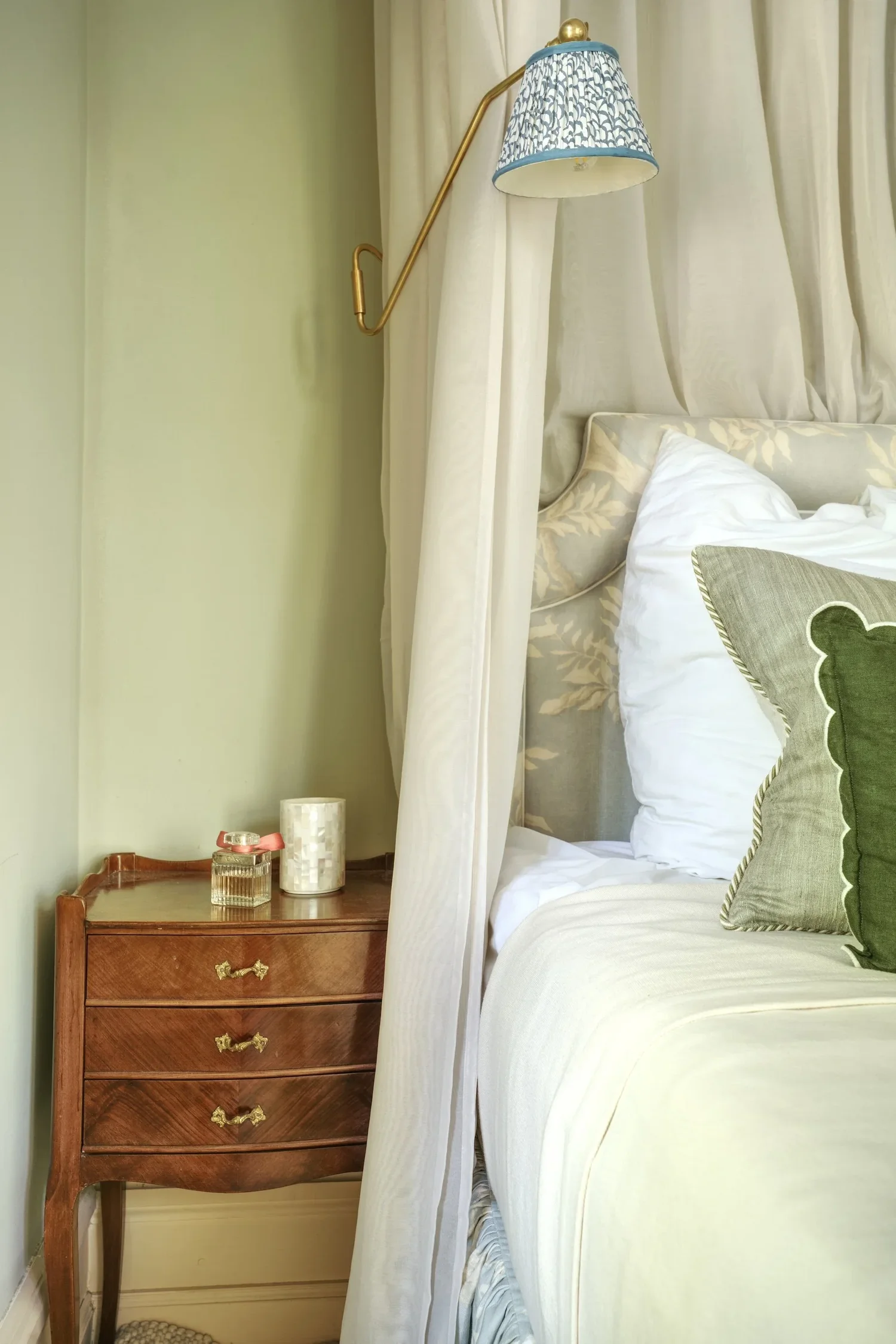
View this post on Instagram
A canopy above the bed and botanical prints hung in a tall grid draw the eye up, in a bedroom by Salvesen Graham.
The practical challenges of a period villa
Hanging chandeliers. A large chandelier is heavy. Before ordering one, check what is behind the ceiling rose and whether the fixing will carry the weight. In an old ceiling this is not always a given.
Curtain fixings. The same applies to walls and window surrounds. Check that they will hold a pole or track and the weight of interlined curtains before the curtains are made.
Deep window reveals and radiators. Villa windows often sit in deep reveals with a radiator beneath. Full-length curtains drawn across them can block the heat. In the villa we live in, our curtain installer's visit changed the plan: in those rooms we were advised to fit blackout blinds inside the reveal and to hang the curtains either side as dress curtains, which do not need to close.
Shutters, blackout and mosquitoes. Many villas sit near a stream, a lake or woodland, and on summer evenings opening the windows to close the shutters can let in mosquitoes. In bedrooms, blackout curtains or blinds mean you can make the room dark without opening the window at all.
Damp and maintenance. In our experience, Swiss period houses tend to be very well maintained, and serious damp or neglect seems less common than in many older houses elsewhere. A survey before purchase is still worthwhile.
Sourcing traditional pieces in Switzerland
This is the part international families tend to underestimate. Switzerland's kitchen, bathroom, furniture and tile makers largely specialise in contemporary design, so if you want a traditional English-style kitchen, upholstery in the English manner, or a half tester and bed canopy, you will need to look further afield.
Before any work can begin, it is worth deciding:
Where the kitchen and bathrooms will come from. Often the UK, with installation arranged in Switzerland.
Who will make the upholstery, curtains and bed hangings. A workshop in Switzerland, or abroad.
How pieces will reach the house. Imports into Switzerland carry 8.1% import VAT, and courier clearance fees per parcel add up quickly. (Our guide to interior design costs in Switzerland covers these in detail.)
Moving to Switzerland with a traditional design style that we were not willing to compromise on meant we spent a great deal of time solving exactly this problem. When we work with clients, these trade relationships and supply routes are already in place, so traditional pieces reach the house without the trial and error.
View this post on Instagram
A painted Plain English kitchen with a yellow island, designed by SGS Design Interiors.
How long does it take to renovate a historic villa?
Every house is different, but these are realistic timeframes:
Paint and wallpaper. Good painters and paperhangers can often start within a couple of weeks.
Designing the scheme. Allow at least two months to design the rooms, plus any wait for your designer's next start date.
Furnishings. Beautifully made furniture, curtains and upholstery typically take 12 to 16 weeks to make, plus shipping, import and an installation day.
A Full Service project. For a decorating and furnishing project, plan on six months or more.
Construction. Add several months for anything involving an architect and builder: new kitchens, bathrooms, tiling and joinery.
A whole-house renovation. Allow one to two years.
If the kitchen and bathrooms need replacing before you can live comfortably, plan where you will live in the meantime.
Here at Deirdre von Gruben we give our attention to one project at a time. That means we move quickly once your project begins, though there can be a short wait before we start. For homes in Switzerland, Full Service Design takes a villa from the first plans to the installed rooms. If you would rather manage the ordering and installation yourself, Online Design is available to clients in Switzerland as well as abroad, and can usually start sooner.
What to do in your first month
Speak to the Denkmalpflege, ideally before you buy, about what can and cannot change.
Bring in your interior designer early, alongside your architect and builder. A villa involves hundreds of decisions and a steady stream of deliveries, painters, paperhangers and curtain fitters; it is much easier when one person holds the plan.
Set a realistic timeline, and decide where you will live while the kitchen and bathrooms are done.
Plan your sourcing: where the kitchen, upholstery and traditional pieces will come from, and how they will reach Switzerland.
View this post on Instagram
An enfilade through the panelled rooms of Newhailes, near Edinburgh. Photograph by James Coviello.
Frequently asked questions
Can you change a listed villa in Switzerland?
Yes, but changes to a listed house are reviewed by the cantonal heritage office. Protection is decided house by house and may cover the facade, the windows or particular interior features such as parquet, stucco or a tiled stove, so speak to the Denkmalpflege early, ideally before you buy.
Should you keep a tiled stove?
It is a personal choice. Keep it if you love its history; if it does not suit how you want to use the room, removal is a reasonable conversation to have with your heritage contact.
Does English country style suit a Swiss villa?
Very well. Swiss and English villas of the 19th century share the same European architectural roots, and the generous, symmetrical rooms of a Swiss villa suit layered fabrics, antiques and pattern.
How long does it take to furnish a villa?
For a decorating and furnishing project, plan on six months or more; add several months for construction, and one to two years for a whole-house renovation.
Bringing it together
A period villa rewards patience. Keep the floors, joinery and details you would choose again, have the heritage conversation early, give the rooms furniture of the right scale, and plan your sourcing before the first painter arrives. The result is a home that feels as though it has always looked this way.
If you have recently bought a period villa, or are about to, please do get in touch. We would love to hear about it, whether through Full Service Design for homes in Switzerland or Online Design.